
Clinical-Grade Cosmetic Testing & Skin Diagnostic Systems
Explore our CE-certified optical diagnostic hardware engineered for quantitative dermatological efficacy trials, high-resolution 3D topography, and AI-driven deep-layer spectral analysis.


1. Executive Summary & Paradigm Shift in Cosmetic Efficacy Testing
The global cosmetic, pharmaceutical, and personal care industries are undergoing an unprecedented paradigm shift driven by stringent international regulatory standards (such as EU Regulation EC 1223/2009) and increasingly demanding consumers seeking scientifically validated results. Traditional subjective scoring systems—such as visual visual grading scales, self-assessment questionnaires, and basic 2D photography—are no longer sufficient to substantiating premium cosmetic claims. Today, leading Contract Research Organizations (CROs), cosmetic formula manufacturers, and clinical trial centers require high-precision, objective, reproducible, and non-invasive diagnostic technologies.
As a premier OEM/ODM factory and CE-certified manufacturer of cosmetic clinical testing equipment, our manufacturing facility specializes in bridging optical physics, algorithmic spatial reconstruction, and multi-spectral AI diagnostic engineering. Devices such as the Antera 3D® platform and our multi-spectral facial scanners deliver sub-micron resolution metrics across wrinkle depth, micro-relief surface roughness ($R_a$, $R_z$), melanin distribution, hemoglobin concentrations, and pore volume. By standardizing quantitative metrics, our instruments empower clinical researchers to prove active ingredient efficacy with mathematical certainty.
Clinical Efficacy Takeaway: Modern cosmetic claims (e.g., "reduces wrinkle depth by 18% in 14 days") require high-resolution 3D surface topography and calibrated multi-spectral imaging to withstand regulatory audit by the FDA, EU SCCS, and global health authorities.
Key Methodological Advantages over Traditional Diagnostics
Unlike conventional skin observation cameras, clinical testing equipment certified under CE standards integrates rigid optical calibration, polarized light isolation, and photometric stereo algorithms. This eliminates environmental lighting interference, operator bias, and patient positioning discrepancies—ensuring intra-individual and inter-individual baseline repeatability during multi-center 28-day or 90-day clinical longitudinal studies.
Core Scientific Features of Clinical Diagnostic Instruments
Engineering optical precision to support pharmaceutical-grade clinical trials and aesthetic validation.
Multi-Spectral Illumination
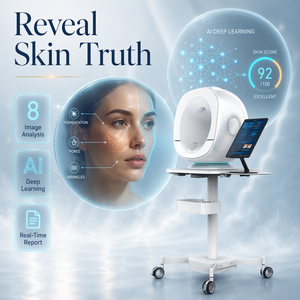
Utilizes up to 9 distinct LED spectral bandwidths—including RGB Standard, Cross-Polarized, Parallel-Polarized, UV 365nm, and Wood’s Light—to isolate epidermal vs. dermal structures without biopsy.
3D Photometric Stereo
Mathematical surface reconstruction maps skin topography down to micrometric levels, quantifying surface roughness ($R_a$), deep crease volumes, fine lines, and skin texture elasticity coefficients.
Chromophore Mapping
Patented spectral analysis algorithms measure exact concentration maps of Melanin (hyperpigmentation, solar lentigines) and Hemoglobin (erythema, rosacea, vascularization) separately.
2. Optical Physics & Algorithmic Foundations of 3D Skin Analysis
To understand the competitive edge provided by factory-direct CE-certified clinical testing equipment, one must examine the optical principles underlying modern skin analysis systems. Human skin is an optically complex, multi-layered semi-transparent turbid medium. Light entering the skin undergoes scattering, absorption, and specular reflection depending on wavelength, incidence angle, and tissue structure.
Cross-Polarization and Parallel Polarization Optics
Specular reflection off the stratum corneum (the skin’s outermost layer) creates glare that masks deeper dermal structures. By utilizing linear polarizing filters on illumination sources and optical sensors oriented at 90-degree cross-angles (Cross-Polarized Light), specular reflection is eliminated. This permits light that has underwent multiple back-scattering events within the epidermis and dermis to be captured, exposing sub-surface chromophores including melanin deposits and capillary networks.
Conversely, Parallel-Polarized Light highlights surface specular reflection, maximizing contrast for surface texture, fine lines, scale, pore opening boundaries, and stratum corneum roughness.
Photometric Stereo & 3D Topographical Reconstruction
Photometric stereo technology illuminates the skin from multiple precisely defined angles sequentially while keeping the optical camera sensor static. By measuring the variation in light intensity across surfaces illuminated from different directions, the system calculates the local surface normals ($dZ/dX, dZ/dY$) for every individual pixel. Integrating these surface normals yields a 3D elevation map with microscopic accuracy.
| Diagnostic Parameter | Optical Measurement Spectrum | Clinical Metric Output | Primary R&D Application |
|---|---|---|---|
| Wrinkle & Fine Line Depth | Parallel-Polarized / Photometric 3D | Depth ($\mu m$), Area ($mm^2$), Volume ($mm^3$) | Anti-Aging & Collagen Peptide Verification |
| Melanin Concentration Index | Narrowband RGB + Spectral Reflectance | Hyper-pigmentation Area Index & Density | Brightening, Whitening & Spot Reduction Trials |
| Vascular Erythema Index | Cross-Polarized Red/Green Ratio | Hemoglobin Concentration Map ($mg/cm^3$) | Soothing, Anti-Inflammatory & Rosacea Care |
| Pore Volume & Sebum Mapping | UV 365nm + Fluorescence Spectrum | Porphyrin Count, Pore Depth & Surface Area | Acne Treatment & Sebum-Control Formulations |
| Skin Surface Roughness ($R_a$) | High-Definition 3D Stereo Mapping | $R_a$ (Average Roughness), $R_z$ (Max Height) | Moisturizer, Exfoliant & Skin Barrier Repair |
Our OEM factory implements precise factory spectral calibration using spectrophotometric target standards, guaranteeing that equipment deployed across diverse global trial sites produces harmonized, reproducible data suitable for clinical submission.
3. Enterprise Manufacturing Advantages & OEM/ODM Superiority
Selecting a manufacturing partner for medical and cosmetic testing equipment requires evaluating technical competence, factory infrastructure, quality management systems, and long-term hardware-software lifecycle support. Our state-of-the-art facility integrates end-to-end design, optical fabrication, firmware development, and AI software engineering under one roof.
Factory R&D and Manufacturing Standards
Our enterprise operations adhere strictly to international manufacturing quality management systems, specifically ISO 13485 (Medical Devices Quality Management Systems) and ISO 9001. Every diagnostic system manufactured in our facilities undergoes rigorous quality control protocols, including spectral calibration, optical alignment testing, thermal stability stress-testing, and Electromagnetic Compatibility (EMC) verification according to IEC 60601-1-2 standards.
Full OEM/ODM Integration
From industrial enclosure customization and branded GUI software interfaces to full SDK integration with client ERP/CRM systems, we provide tailored manufacturing for global brands.
Strict Quality Assurance
100% automated optical sensor calibration, zero-pixel defect tolerances, and thermal drift compensation ensure stable clinical data across fluctuating ambient conditions.
Through our dedicated hardware R&D division and collaborations with European optical research institutes, we maintain continuous innovations in high-frame-rate CMOS sensors, custom LED narrow-band filtering, and multi-language support (enabling smooth operations in over 25 native languages across global study centers).
4. Global Sourcing Trends & Future Procurement Outlook (2026–2030)
As the international beauty and dermatological sectors enter the era of precision cosmetics and personalized skin longevity therapies, procurement strategies for testing equipment are evolving rapidly. B2B buyers must anticipate upcoming technological shifts to ensure long-term equipment utility and compliance.
Trend 1: Deep Learning & AI-Powered Longitudinal Predictive Modeling
Modern clinical trial equipment is moving beyond static metric measurements toward generative AI aging trajectory models. Advanced AI algorithms process over 30 skin dimension data points—ranging from deep dermal pigmentation mapping to localized collagen density indexes—enabling researchers to simulate 5-year or 10-year post-treatment outcomes for active compounds.
Trend 2: Cloud Data Synchronization & Multi-Center Clinical Harmonization
Global cosmetic conglomerates frequently run simultaneous clinical trials across diverse geographic cohorts (e.g., North America, Europe, East Asia). Future-proof equipment features encrypted cloud synchronization, DICOM compliance, and standardized calibration routines that allow R&D directors to consolidate live clinical data from dozens of regional CROs into a centralized data repository instantly.
Trend 3: Miniaturization & High-Precision Handheld 3D Imaging
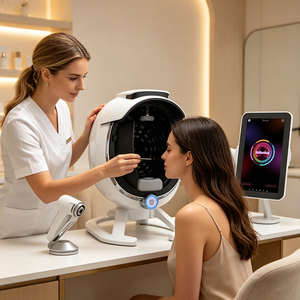
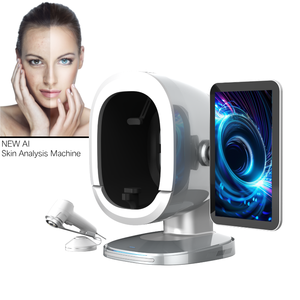
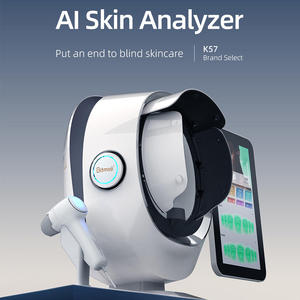
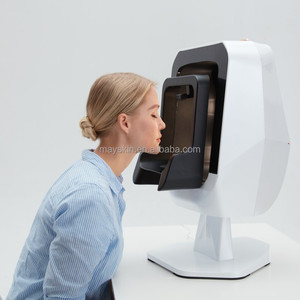
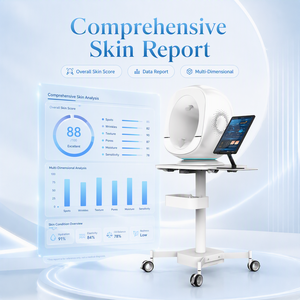
While full-face stationary diagnostic booths (like the X5PRO 9-Spectral and A6 3D Scanner) remain the benchmark for comprehensive facial analysis, there is expanding demand for clinical-grade portable 3D scanners (such as the Antera 3D® series). Portable instruments allow localized, sub-millimeter measurements on specific anatomical sites—such as periorbital crow's feet, nasolabial folds, or forearm patch testing zones.
5. Regulatory Framework & CE Certification Standards
Navigating the complex regulatory landscape of international market entry requires certified diagnostic equipment. CE certification guarantees that our devices comply with essential health, safety, and environmental protection standards established by the European Union.
Key Compliance Certifications Maintained by Our Manufacturing Facilities:
- CE Low Voltage Directive (LVD) 2014/35/EU: Ensures complete electrical safety, optical radiation safety (photo-biological safety IEC 62471 for LED illuminators), and system power isolation.
- CE Electromagnetic Compatibility (EMC) Directive 2014/30/EU: Guarantees that diagnostic devices generate no electromagnetic interference and remain immune to external RF radiation in clinical environments.
- RoHS Directive 2011/65/EU: Strict restriction of hazardous substances in electrical and electronic component manufacturing.
- ISO 13485 Medical Devices Quality Management: Accredited manufacturing lines ensuring full traceability, validation, and risk management (ISO 14971) across every unit produced.
By purchasing directly from a CE-certified factory, procurement officers avoid costly customs delays, regulatory rejections, and legal non-compliance risks during international trial execution.
Frequently Asked Questions (B2B Sourcing FAQ)
Addressing critical technical, regulatory, and procurement questions for enterprise buyers.