
The global field of clinical dermatology, cosmetic R&D, and aesthetic diagnostics has undergone a profound technological shift. Advanced dermatological surface analysis systems are no longer mere photo-documentation tools; they are high-precision quantitative optical instruments capable of measuring sub-micron topographic variations, subsurface chromophore concentrations, and structural dermal degradation. As China consolidated its position as an international epicenter for precision biomedical optical engineering and ISO13485-certified medical device manufacturing, global B2B buyers, Contract Research Organizations (CROs), and aesthetic equipment distributors increasingly source high-performance surface analysis systems directly from leading Chinese original equipment manufacturers (OEM/ODM).
Information Gain & Technical Insight: Modern 3D dermatological surface analysis leverages photometric stereo imaging, cross-polarized multispectral separation, and deep learning spatial mapping to eliminate shadow artifacts, quantify wrinkle volume in cubic millimeters ($mm^3$), and isolate epidermal melanin from deep vascular hemoglobin with clinical reproducibility (ICC > 0.95).
Recommended Commercial Dermatological Surface & Subsurface Analyzers
Below is an curated selection of top-tier, clinically validated dermatological surface analysis platforms engineered by premier China manufacturers for commercial aesthetic clinics, research labs, and mobile dermatology practices.
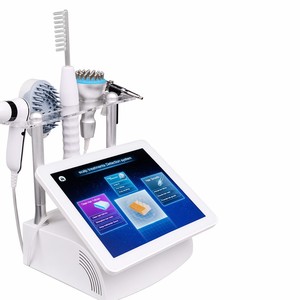
- 200X Microscopic Lens Resolution
- 15.6" Ultra-Clear Touch Display
- Dual Mode: Facial & Follicular Scalp

- Multispectral RGB/UV/PL Light
- Deep Epidermal Dermatoscope
- Automated Pathology Mapping

- 3D Surface Topography Mapping
- Subsurface Dermal Volumetrics
- Scalp & Hair Density Scoring
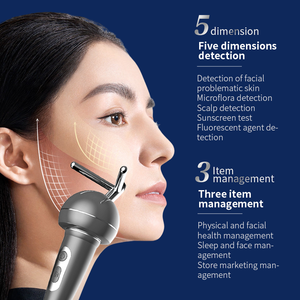
- Sunscreen Coverage Verification
- Microscopic Barrier Inspection
- Automated Product Matching
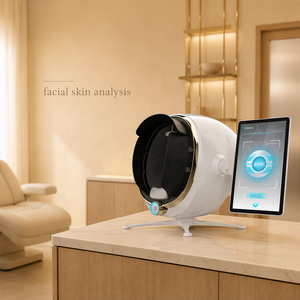
- Collagen Index Quantification
- UV Porphyrin & Acne Mapping
- Comprehensive PDF Clinical Reports
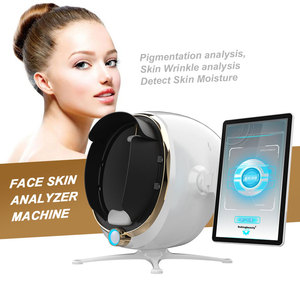
- Compact Lightweight Form Factor
- High-Speed Digital Sensor
- Multi-Angle Surface Scanning

- 17+ Clinical Diagnostic Biomarkers
- Deep Dermal Layer Decomposition
- Enterprise Cloud Multi-Device Sync
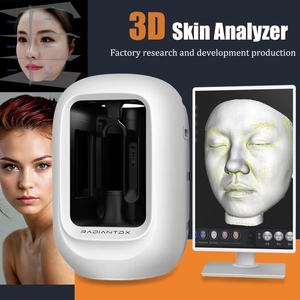
- Enclosed Constant-Illumination Chamber
- Sub-Millimeter 3D Mesh Reconstruction
- AI Neural Network Age & Metric Engine
Whitepaper: The Scientific Evolution of Dermatological Surface Analysis
To accurately evaluate dermatological health, measure anti-aging clinical trial efficacy, or prescribe targeted aesthetic interventions, objective quantitative data is mandatory. Historical dermatological assessment relied on subjective qualitative visual grading scales (e.g., Griffiths' Scale), which suffered from high inter-observer variability. Modern dermatological surface analysis systems manufactured in China incorporate advanced optical principles that convert photons reflected from the stratum corneum and reticular dermis into standardized numerical metrics.
1. Photometric Stereo & 3D Micro-Relief Topography Reconstruction
Surface roughness ($R_a$), peak-to-valley roughness ($R_z$), and wrinkle volume ($mm^3$) cannot be measured accurately using conventional 2D planar photography due to ambient light distortion. Advanced systems utilize photometric stereo imaging. By sequentially illuminating the skin surface from multiple predefined directional angles using high-CRI (Color Rendering Index $\ge 95$) LED arrays, the system captures variations in shadow geometry. Specialized computer vision algorithms calculate surface normal vectors at every pixel, constructing a sub-millimeter 3D elevation map of the skin's surface texture.
This 3D surface topography allows clinical researchers to precisely quantify fine lines, deep nasolabial folds, pore volume, and skin smoothing effects following cosmetic interventions or energy-based medical aesthetic procedures (such as fractional CO2 laser resurfacing or microneedling RF).
2. Multispectral Polarized Light Separation
Light interacting with human skin undergoes specular reflection at the stratum corneum and diffuse illumination scattered within the deeper epidermal and dermal layers. Chinese clinical skin analyzer manufacturers employ multi-mode spectral filtration:
- Standard RGB White Light: Captures true-color surface morphology, macroscopic lesions, and visible pore distribution under controlled color-temperature conditions ($5500\text{K}$).
- Parallel Polarized Light (PPL): Enhances specular surface reflection, highlighting subtle micro-relief alterations, dry desquamation, fine surface lines, and cuticle structure.
- Cross-Polarized Light (XPL): Cancels specular glare from the skin surface, allowing light to penetrate into the upper dermis. This mode reveals subsurface vascular structures, teleangiectasia, erythema, and deep dermal inflammation.
- Deep Ultraviolet Light ($365\text{nm}$ Wood's Light Equivalent): Excites skin fluorophores. Porphyrins produced by Propionibacterium acnes fluoresce red/orange, while epidermal melanin absorbs UV light intensely, uncovering hidden hyperpigmentation, sun damage, and disrupted skin barrier permeability before it becomes clinically visible on the surface.
3. Spectral Chromophore Separation: Melanin vs. Hemoglobin
Utilizing mathematical optical absorption models based on the Beer-Lambert law, advanced diagnostic software isolates the specific absorption spectra of oxy-hemoglobin/deoxy-hemoglobin ($542\text{nm}$ and $577\text{nm}$) and melanin ($300\text{nm} - 1000\text{nm}$). This algorithmic separation produces independent concentration maps, allowing dermatologists to differentiate post-inflammatory hyperpigmentation (PIH) from vascular rosacea or diffuse erythema with high analytical accuracy.
Strategic Procurement Trends: Why Source Skin Analyzers from China Manufacturers?
The market for skin imaging diagnostics has evolved rapidly. Historically dominated by Western clinical research equipment suppliers, the market has seen a major paradigm shift. Top Chinese manufacturers have invested heavily in proprietary optical lens manufacturing, industrial camera sensors, and artificial intelligence diagnostic software. Today, China-manufactured dermatological surface analysis systems offer world-class clinical capabilities at a highly competitive Total Cost of Ownership (TCO).
Optical Hardware Integration
Leading Chinese factories leverage high-grade optical glass lenses, industrial-grade Sony CMOS sensors (ranging from 16MP to 28MP resolution), and custom-built LED light rings with zero spectral decay over 50,000 operational hours.
AI Deep Learning Algorithms
Integrated neural networks trained on multi-ethnic clinical skin databases (over 10,000,000 annotated facial images) enable instant automated classification of skin age, sebum production, pore clogging, and wrinkle severity grades.
Agile OEM / ODM Customization
China manufacturers excel in flexible production lines, offering white-label software UI customization, hardware chassis design, custom SDK integration for hospital EMR systems, and localized multi-language database support.
System Specification Benchmark: Comparison of Technology Tiers
| Diagnostic Feature | Basic 2D Camera Analyzer | Standard Dermatoscope System | Advanced 3D AI Multispectral Chamber |
|---|---|---|---|
| Optical Modes | Single RGB Light | RGB + Cross-Polarized Light | RGB + PPL + XPL + UV (365nm) + Wood's Light |
| 3D Wrinkle & Volume Mapping | Not Available (2D Overlay) | Qualitative Estimation | Quantitative Photometric Topography ($mm^3$) |
| Chromophore Separation | Basic RGB Color Channels | Melanin Index Only | Independent Melanin & Hemoglobin Concentration Maps |
| Image Sensor Resolution | 5 MP - 12 MP | 12 MP - 16 MP | 20 MP - 28 MP Industrial Grade CMOS |
| Clinical Efficacy Validation | Subjective Comparison | Semi-Quantitative Reports | Full CRO Statistical Export (CSV, DICOM, PDF) |
| Illumination Environment | Uncontrolled Ambient Light | Handheld Contact Probe | Enclosed Constant-Illumination Chamber |
B2B Buyer’s Guide: Evaluating China Surface Analysis System Manufacturers
When selecting an OEM or ODM manufacturing partner in China for medical aesthetic devices or dermatological analysis platforms, procurement teams must look beyond superficial specs and conduct deep technical diligence across four critical pillars:
1. Calibration Protocol & Lighting Uniformity
Quantitative longitudinal studies (e.g., testing a anti-wrinkle cream over a 90-day trial) require absolute light constancy. Ensure the manufacturer implements automated internal hardware calibration routines and uses regulated power supplies to prevent LED intensity fluctuations or color temperature drift over time.
2. Software Reproducibility (ICC Metrics)
Request the manufacturer's clinical validation reports demonstrating high Intraclass Correlation Coefficients (ICC > 0.90) for repeat scans taken on the same subject under identical conditions. High repeatability is crucial for medical publications and regulatory claims.
3. Data Privacy & Compliance Infrastructure
For systems utilizing enterprise cloud storage or AI model training, verify compliance with international data privacy standards, including HIPAA (Health Insurance Portability and Accountability Act) for the United States and GDPR (General Data Protection Regulation) for the European Union. Software should feature AES-256 encrypted local databases and secure patient record anonymization modes.
Frequently Asked Questions (FAQ) - B2B Sourcing & Technical Analysis
Enterprise Manufacturing Strength & OEM Services
As a global leader in dermatological diagnostics and optical surface testing machinery, our manufacturing facilities adhere to strict medical device production protocols. We provide end-to-end industrial manufacturing, from optical lens grinding and sensor assembly to proprietary software development and global after-sales engineering support.
ISO 13485 Cleanroom Production
Our state-of-the-art optical manufacturing facility features dust-free assembly cleanrooms, ensuring zero microscopic particulate contamination during lens housing and optical sensor calibration.
International Certification Compliance
All surface analysis machines are fully certified according to international quality and safety directives, holding CE, FCC, RoHS, and medical-grade electrical safety compliance certificates.
Global Technical Support & Logistics
We provide global B2B clients with remote software diagnostic updates, rapid spare-parts dispatch, online clinical training academies, and comprehensive 2-year hardware warranties.
Partner with China's Leading Dermatological System Manufacturer
Whether you require standard clinical diagnostic equipment, customized OEM skin analyzers, or multi-center research platforms, our engineering team is ready to support your technical specifications.