
Executive Summary: The OEM/ODM Landscape for Digital Skin Moisture Testers
In the rapidly evolving global beauty-tech and dermatological diagnostics market, the procurement of Custom OEM Digital Skin Moisture Testers has shifted from basic promotional white-label gadgets to hyper-accurate, medical-grade diagnostic instruments. Modern cosmetic brands, clinical research organizations (CROs), and aesthetic equipment distributors require hardware manufacturing partners capable of integrating advanced bio-electrical impedance analysis (BIA), high-frequency micro-capacitance arrays, and multi-spectral optical cross-verification into ergonomic, market-ready form factors.
This technical whitepaper provides B2B procurement directors, product managers, and R&D engineers with an exhaustive analysis of digital skin moisture tester factory capabilities, hardware architecture customization, sensor precision engineering, regulatory compliance frameworks (ISO 13485, IEC 60601-1, FDA Class II registration paths), and future manufacturing trends shaping the 2026–2030 diagnostic horizon.
Physics & Sensor Modalities: How Custom OEM Moisture Testers Quantify Stratum Corneum Hydration
To evaluate a manufacturing facility's OEM capability, one must first understand the physics behind stratum corneum (SC) water content measurement. Water possesses an exceptionally high dielectric constant (εr ≈ 80 at 20°C) compared to dry skin proteins and lipids (εr ≈ 2–5). OEM digital skin moisture testers exploit this physical disparity through three primary sensor modalities:
1. High-Frequency Bio-Capacitance Sensing (Corneometry Standard)
Industrial-grade moisture testers utilize a high-frequency (typically 1.0 MHz to 3.5 MHz) electric field generated through a glass-coated or gold-plated interdigital probe structure. When pressed gently against the epidermis, the sensor measures the change in dielectric capacitance, which directly correlates to the moisture level in the top 10 to 20 micrometers of the skin layer. OEM factories specializing in bio-capacitance probes must guarantee minimal stray capacitance and zero signal cross-talk via shielded PCB layouts.
2. Multi-Frequency Bioelectrical Impedance Analysis (BIA)
Advanced commercial and clinical handheld devices combine hydration reading with oil (sebum) estimation by measuring complex electrical impedance ($Z = R + jX$) across dual micro-electrodes. By sweeping alternating currents from 10 kHz up to 500 kHz, the device calculates cell membrane integrity and moisture retention capability within sub-epidermal layers, allowing custom algorithms to differentiate between topical surface moisture (e.g., post-cream application) and deep cellular hydration.
3. Photometric Stereo & Optical Cross-Correlation
Next-generation OEM hardware integrates contact capacitance probes with 470nm cyan/blue LED cross-polarized illumination. Optical sensors capture light scatter alterations caused by keratin hydration states, offering cross-validation against electrical readings to eliminate user error caused by uneven probe contact pressure.
Factory Procurement Insight: Inferior OEM factories often use uncalibrated resistance-based probes susceptible to perspiration salinity, skin pH, and ambient humidity. Premium OEM facilities implement automated multi-point dielectric fluid calibration rigs to ensure every unit leaving the assembly line achieves a correlation coefficient of r > 0.95 against gold-standard clinical corneometers.
OEM/ODM Customization Architecture: Hardware, Firmware & Software Engineering
Partnering with a dedicated OEM skin analyzer factory enables brands to customize the entire diagnostic ecosystem. Factory engineering capabilities are divided into three core OEM customization tiers:
24K gold-plated electrode probes, medical-grade ABS/PC housings, OLED/TFT display integration, custom capacitive touch panels, USB-C fast charging, and IPX5/IPX7 waterproof sealing.
Proprietary DSP noise filtration, custom hydration/oil/elasticity scoring matrix, temperature-compensated dielectric calibration, multi-language UI, and BLE 5.2/Wi-Fi wireless protocols.
White-label iOS/Android apps, SaaS diagnostic dashboards, RESTful cloud APIs, AI product recommendation engines, and HIPAA/GDPR compliant encrypted customer database sync.
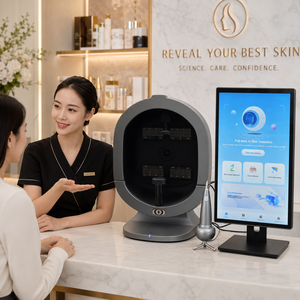
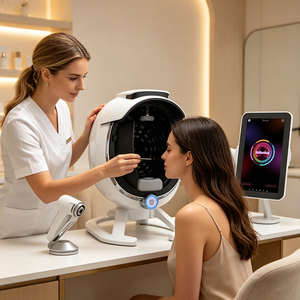
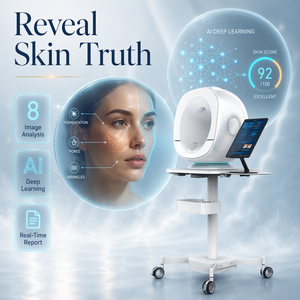
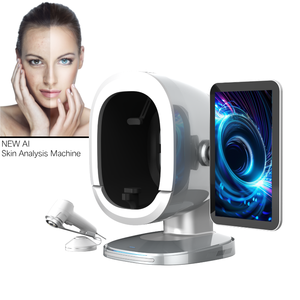
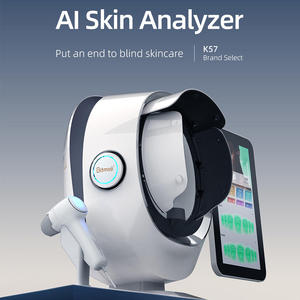
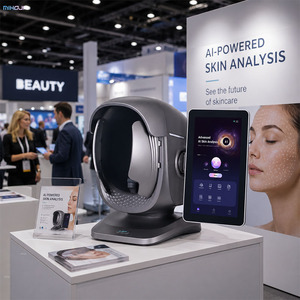
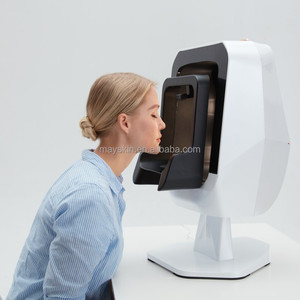
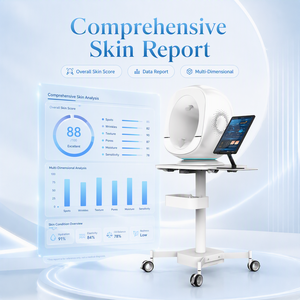
Technical Comparison: Entry-Level Consumer vs. OEM Commercial vs. Clinical 3D Multi-Spectral Scanners
When sourcing digital skin moisture testers from OEM factories, procurement teams must align device specs with their targeted retail or clinical market segment:
| Specification / Parameter | Consumer Promotional OEM | Commercial Beauty Salon OEM | Clinical 3D AI Analyzer OEM |
|---|---|---|---|
| Measurement Method | Single-Frequency DC Resistance | High-Freq Dual-Capacitance | Bio-Impedance + 9-Spectral Photometry |
| Sensor Probe Coating | Standard Nickel Plating | 24K Hard Gold Plating | Biocompatible Titanium/Ruby Contact |
| Sampling Speed | 1.5 – 2.0 seconds | < 500 milliseconds | Real-time continuous scanning |
| Hydration Resolution | 1.0% steps | 0.1% fine resolution | 0.01% quantitative clinical index |
| Wireless Connectivity | Bluetooth 4.2 BLE | BLE 5.2 + Dual-band Wi-Fi | Wi-Fi 6 / Direct Cloud REST API |
| Target Sourcing Unit Cost | $3.50 – $8.50 OEM | $35.00 – $120.00 OEM | $450.00 – $2,500.00 OEM/ODM |
Future Procurement Trends (2026–2030): What Skincare Brands Must Source Today
The skin moisture testing industry is undergoing a structural paradigm shift driven by artificial intelligence, micro-miniaturization, and integrated skin barrier analytics. Forward-looking procurement directors should prioritize factory partnerships that demonstrate technical roadmaps in the following areas:
1. Direct Transepidermal Water Loss (TEWL) Correlation Algorithms
Traditionally, TEWL measurement required bulky open-chamber or closed-chamber evaporimeters. 2026 OEM moisture tester prototypes incorporate dual micro-humidity sensors within a micro-gasketed sensor tip. This allows handheld devices to calculate both stratum corneum hydration and barrier evaporation rates simultaneously in under two seconds.
2. AI-Driven Skincare Formulation Matchmaking
Hardware without software is becoming obsolete. Leading OEM factories are bundling their digital moisture meters with cloud-hosted AI algorithms. Upon taking a cheek or forehead hydration reading, the companion app performs instant matrix cross-referencing against the brand's SKU portfolio, recommending specific serums or moisturizers based on real-time skin deficit metrics.
3. Continuous Wireless Bio-Impedance Patches
Expanding beyond rigid handheld probes, advanced OEM factories are investing in flexible PCB assembly lines to manufacture wearable skin hydration sensors. These ultra-thin micro-fluidic patches transmit 24-hour hydration telemetry to mobile applications, opening new avenues for clinical trial monitoring and premium prescription skincare routines.
Factory Quality Assurance & Regulatory Compliance Standards
Sourcing diagnostic hardware demands strict adherence to international quality management systems. A reliable OEM digital skin moisture tester factory must provide documented compliance across the following standards:
• ISO 13485:2016 Certification: Guarantees that the factory maintains a medical device quality management system covering design controls, supplier verification, cleanroom assembly, and full lot traceability.
• ISO 10993 Biocompatibility Testing: Probe materials in contact with skin must pass cytotoxicity, sensitization, and intracutaneous reactivity testing to prevent contact dermatitis or adverse client reactions.
• EMC & Electrical Safety (IEC 60601-1 / CE / FCC): High-frequency bio-capacitance circuits must comply with electromagnetic compatibility standards to prevent radio frequency interference and ensure patient electrical safety.
B2B Procurement & Customization FAQ
Whether you require white-label digital skin moisture testers, custom 3D facial analyzers, or custom IoT hardware development, our engineering team provides turnkey OEM/ODM solutions tailored to your technical and business requirements.