
Featured Commercial Skin Analysis & Dermatoscope Systems
Explore our ISO 13485-certified, high-precision diagnostic devices available for OEM custom branding, ODM hardware engineering, and bulk international supply.
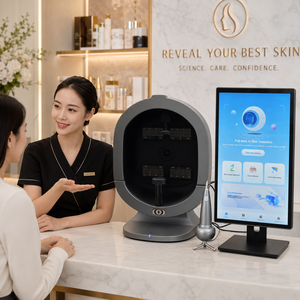
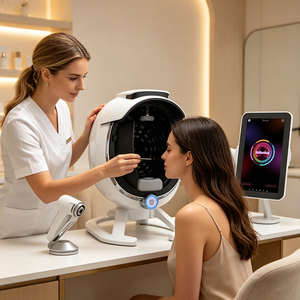
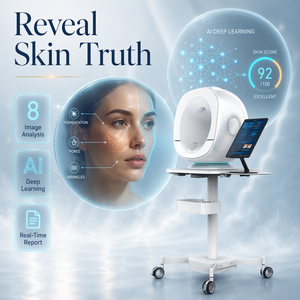
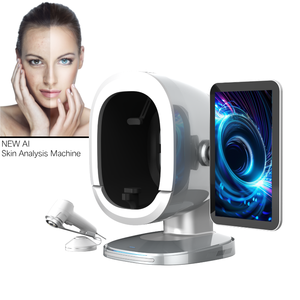
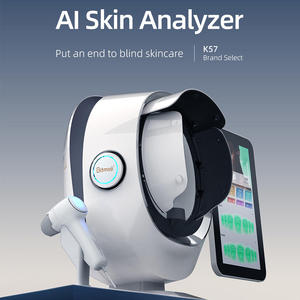
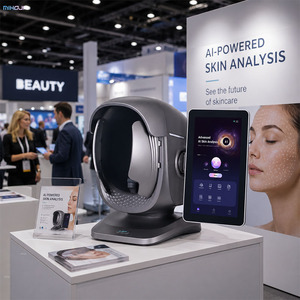
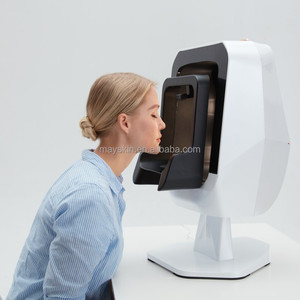
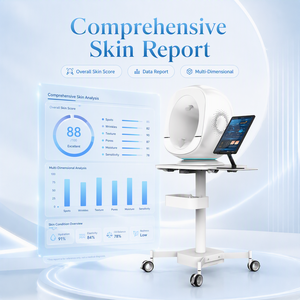
The Technological Architecture of Next-Gen Aesthetic Dermatoscope Systems
Transforming subjective dermatological evaluation into objective, quantitative dermal analytics through multi-spectral optical physics and deep-learning spatial algorithms.
Photometric Stereo & 3D Surface Mapping
Legacy 2D dermoscopy captures flat imagery, missing crucial depth metrics. Our OEM/ODM systems utilize patented photometric stereo technology. By illuminating skin tissue from multiple controlled directions in milliseconds, the system reconstructs an exact sub-millimeter 3D topography. This enables precise volumetric calculation of wrinkle depth, skin roughness (Ra, Rz parameters), pore capacity, and scarring elevation.
Multi-Spectral Optical Demixing
Integrating RGB white light, cross-polarized, parallel-polarized, and UV light (365nm), our systems split optical reflection into discrete chromophore maps. Utilizing proprietary spectral demixing algorithms, the device isolates Melanin concentration (epidermal pigment, age spots) and Hemoglobin distribution (vascular erythema, rosacea, inflammation) without skin biopsy or invasive procedures.
Deep Learning Diagnostic Engines
Engineered for commercial aesthetic practices and clinical research organizations (CROs), our embedded AI software cross-references scanned parameters against a database of over 1 million clinical cases. The automated engine scores 30+ detection dimensions, providing objective verification for pre-and-post treatment anti-aging, laser therapy, and topical product validation.
Future Procurement & Industry Trends in Aesthetic Dermatoscope Systems (2026–2030)
As the global medical aesthetics market accelerates toward hyper-personalization, B2B procurement vectors are undergoing a structural transformation. Medical equipment distributors and brand owners must adapt to key shifts.
1. Convergence of Diagnostics & Treatment Modalities
Global buyers are shifting away from standalone, passive diagnostic scanners. Modern procurement demands interoperable skin analysis engines capable of direct API integration with energy-based treatment devices (such as RF microneedling, picosecond lasers, and HIFU platforms). Future OEM contracts prioritize unified software ecosystems where skin diagnostic data directly drives treatment parameters.
2. Quantitative Efficacy Tracking for CROs & Cosmetics
Cosmetic manufacturers and pharmaceutical CROs require reproducible, publication-ready data to back claim validation (e.g., "30% reduction in wrinkle volume over 4 weeks"). Modern dermatoscope procurement relies on system stability, exact lighting calibration, and spatial alignment software that eliminates human positioning error across multi-center clinical trials.
3. Cloud-Native Tele-Dermatology & SaaS Monetization
Enterprise buyers demand cloud-synced patient management systems (HIPAA/GDPR compliant) that allow multi-location aesthetic chains to centralize diagnostic records. Suppliers providing SDK access, multi-language localization (19 to 25+ languages), and cloud architecture enable distributors to build recurring software revenue models alongside hardware distribution.
4. Portable High-Resolution Optical Handpieces
While heavy full-face cabin systems remain clinic staples, high-growth demand is targeted toward handheld, high-magnification dermatoscopes equipped with wireless connectivity. Modern medical aesthetics practitioners require point-of-care, microscopic dermoscopy for instant lesion, pigment, and scalp hair-follicle inspection.
System Architecture Comparison: Standard vs. Enterprise OEM/ODM
Review the technical parameters that differentiate entry-level commercial skin analyzers from our clinical-grade OEM/ODM Dermatoscope Systems.
| Feature Parameter | Standard Commercial Analyzer | Enterprise OEM/ODM Dermatoscope System | Clinical Advantage |
|---|---|---|---|
| Optical Spectrum | 3 Spectra (RGB, UV, Polarized) | 4 to 9 Spectra (RGB, PL, UV 365nm, Cross-PL, Red/Blue Light) | Isolates deep dermis vs surface artifacts with zero optical distortion. |
| Topography Measurement | 2D Estimated Pixel Shading | Patented 3D Photometric Stereo Algorithm | Calculates micro-relief, wrinkle depth (µm), and structural volume. |
| Biological Mapping | Basic Color Separation | Melanin & Hemoglobin Concentration Demixing | Quantifies vascular inflammation vs epidermal hyperpigmentation. |
| Software & SDK | Closed System App | Open API / Custom GUI / White-Label SDK | Allows seamless integration into proprietary clinical management platforms. |
| Localization & Language | English / Chinese Only | 19 to 25+ Global Languages Supported | Immediate turn-key deployment across diverse international sales territories. |
| Regulatory Compliance | Basic CE Mark | ISO 13485, CE Medical Device, FDA Ready | Simplifies hospital and clinical chain procurement approval processes. |
Full-Lifecycle OEM/ODM Manufacturing Capabilities
From optical sub-system design to turnkey software localization, our manufacturing infrastructure provides global aesthetic equipment brands with a competitive edge.
Custom Industrial & Hardware Design
We provide bespoke industrial design services for handpieces, cabin enclosures, and integrated camera rigs. Customize optical lens assemblies, LED array spectral outputs, housing materials, and brand aesthetics to match your enterprise product portfolio.
White-Label Software & AI Calibration
Rebrand our diagnostic software UI with your corporate design identity. We offer customized algorithmic tuning for specific skin phototypes (Fitzpatrick scale I–VI), bespoke diagnostic scoring metrics, and local cloud server infrastructure options.
Strict Quality Management & Regulatory Support
Operating under rigorous ISO 13485 quality management systems, every unit undergoes multi-stage optical calibration, spectral purity verification, and thermal endurance testing. We supply full technical dossiers (TCF) to support your regional medical registration.
Frequently Asked Questions for B2B Procurement & Custom Orders
Detailed technical answers to common queries from medical device distributors, cosmetic brand managers, and clinical procurement officers.
Q: What is the Minimum Order Quantity (MOQ) for OEM custom branding vs standard wholesale orders?
For standard wholesale orders of our off-the-shelf skin analyzers, the MOQ is 1 unit. For custom OEM branding (logo laser engraving, custom startup screen, software branding, and custom packaging), the baseline MOQ starts at 5 to 10 units. For full ODM hardware development (custom optical mold, bespoke chassis design), MOQs depend on design complexity and are evaluated during project scoping.
Q: How does 3D photometric stereo skin analysis compare to conventional 2D skin line scanners?
Conventional 2D skin scanners rely solely on ambient flat lighting, which can be easily distorted by room light variations, patient skin moisture, and minor head movement. Photometric stereo captures multiple images under directional illumination in milliseconds, mathematically calculating elevation angles to build a true 3D surface mesh. This allows objective millimeter-level volume calculations for wrinkles, pores, and texture that 2D systems cannot replicate.
Q: Can your dermatoscope software be integrated into our existing clinical clinic management system?
Yes. We provide complete RESTful APIs and software development kits (SDKs) for Windows, Android, and cloud-based platforms. Enterprise buyers can seamlessly stream raw diagnostic images, spectral maps, and quantitative metrics into their proprietary Electronic Health Record (EHR) or CRM systems.
Q: How are spectral lighting sources calibrated to maintain longitudinal measurement consistency?
Each dermatoscope system features closed-loop current feedback control for its custom LED arrays (RGB, Polarized, UV). Prior to shipment, every unit is factory-calibrated using optical integrating spheres. We also supply standardized calibration cards with our systems, enabling clinicians to perform automated self-calibration routines to ensure 100% data reproducibility across years of clinical studies.
Q: What languages are supported by the AI software user interface?
Our standard software architecture natively supports up to 25 languages, including English, Spanish, French, German, Italian, Portuguese, Russian, Arabic, Japanese, Korean, Vietnamese, and Turkish. Additional language packs can be added within 5 business days upon request for enterprise OEM partners.
Q: What after-sales support, warranty, and replacement parts policies do you offer?
We offer a standard 2-year enterprise warranty on all optical hardware and main processing boards, extendable to 5 years via service agreements. In case of component failure, we operate a modular replacement policy—shipping pre-calibrated replacement modules directly via international express to minimize clinical downtime. Software updates and technical support are provided lifetime free of charge.
Partner with a Leading OEM/ODM Aesthetic Dermatoscope Manufacturer
Elevate your product portfolio with clinical-grade 3D imaging technology, custom optical engineering, and global manufacturing support. Request factory-direct pricing, technical specifications, or an engineering consultation today.
Get a Quote