Top Trusted Skin Collagen Density Analyzer Supplier & Exporter
Whitepaper & B2B Procurement Guide: Quantitative Dermal Matrix Profiling, 3D Multispectral Micro-Topography, and Global Medical Aesthetic Supply Standards.
Featured Skin Collagen & Multispectral Analyzer Systems
Explore our B2B export inventory of 3D facial scanners, 9-spectral AI collagen measurement platforms, and clinical research devices compliant with international dermatology standards.
1. Technical Architecture of Non-Invasive Skin Collagen Density Analysis
In contemporary clinical dermatology, aesthetic surgery, and pharmaceutical research, quantifying the structural integrity of the extracellular matrix (ECM) has evolved from invasive skin biopsies to non-invasive optical micro-topography. Collagen density—specifically the ratio of Type I to Type III collagen bundles within the papillary and reticular dermis—serves as the primary biological indicator of skin chronological aging, photo-damage elasticity, and anti-aging cosmetic intervention efficacy.
As a leading manufacturer and exporter of skin collagen density analyzers, our hardware architecture integrates proprietary Photometric Stereo Imaging and Multispectral AI Diagnostics. By projecting calibrated directional light sources across RGB, parallel-polarized, cross-polarized, and ultraviolet wavelengths (ranging from 365 nm UV to 850 nm near-infrared), the analyzer captures subsurface light scattering behavior.
Information Gain Insight: Standard 2D skin cameras merely observe superficial skin tone. Advanced 3D collagen analyzers utilize cross-polarization to neutralize surface specular reflectance, isolating the dermal light backscattering coefficient (μs). This directly correlates with collagen fiber bundle density, micro-vascularity depth, and subcutaneous elastin elasticity.
Photometric Stereo vs. Traditional Optical Coherence Tomography (OCT)
While benchtop OCT scanners provide high-resolution cross-sectional slices, their high capital expenditure ($80,000+) and restricted field of view limit commercial procurement in cosmetic clinical trials and chain MedSpas. Photometric stereoscopy captures full-face 3D surface topographies down to a spatial resolution of 15 to 25 micrometers (μm). This allows automated algorithm mapping of skin roughness (Ra, Rz parameters), pore depth volume, and underlying collagen collapse zones within seconds.
Subsurface Polarized Depth
Eliminates glare to map dermal hemoglobin, melanin distribution, and structural collagen fiber orientation under 9 discrete light spectra.
3D Matrix Topography
Quantifies micro-wrinkle depth, volume, and dermal elasticity variations using high-definition stereoscopic shadow-reconstruction algorithms.
Efficacy Claim Validation
Generates standardized, reproducible quantitative reports essential for CRO cosmetic claims, anti-aging clinical trials, and medical aesthetic consultations.
2. Global Procurement & Technology Trends (2026–2030 Horizon)
As international buyers, aesthetic chain procurement officers, and Contract Research Organizations (CROs) evaluate skin diagnostic equipment, market demands are shifting rapidly toward high-throughput, multi-spectral AI platforms. Key market trends reshaping procurement include:
Trend 1: AI-Driven Quantitative Collagen Mapping
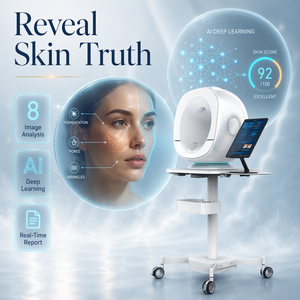
Subjective grading scales (e.g., visual analog scales) are being replaced by automated Deep Neural Networks (DNN). Modern skin analyzers trained on multi-ethnic clinical datasets can calculate a standardized Collagen Index Score (0–100). These systems automatically segment age-related dermal thinning from transient dehydrated lines, giving clinicians objective baseline data.
Large aesthetic franchises demand multi-clinic software synchronization. Equipment must feature HIPAA/GDPR-compliant cloud architecture. Scans taken at location A must seamlessly sync to cloud servers for off-site specialist review or longitudinal patient progress tracking across global clinic networks.
Global exporters must provide firmware and software localized in 19 to 25 languages (including English, Spanish, German, French, Arabic, and Japanese). Furthermore, distributors require white-label software customization, custom UI branding, and integration with clinic management EMR systems.
Benchmarking Diagnostic Paradigms: Traditional vs. 3D AI Collagen Analyzers
Feature / Parameter
Standard 2D Facial Scanners
3D AI Collagen Density Analyzers
Clinical Benchmark (OCT/Ultrasound)
Spectral Illumination
3 Spectra (RGB, UV, Polarized)
4 to 9 Spectra (RGB, Cross, Parallel, UV, Wood)
Single Band Laser / High Freq Sound
Subsurface Collagen Profiling
Estimated via surface shadow
✓ Direct μs Scattering Quantification
✓ High-resolution slice
Wrinkle Depth Resolution
Qualitative visual score
✓ 15μm 3D Topographic Depth
Sub-micron point measurement
Scan & Analysis Speed
20 – 45 Seconds
8 – 15 Seconds
5 – 15 Minutes per zone
Multi-Language Firmware
Basic 2-4 languages
✓ Up to 25 Languages Integrated
English Only (Scientific UI)
Commercial B2B Viability
Low (Outdated Tech)
Optimal for Clinics, CROs & MedSpas
Extremely High Hardware Cost
Why Global Buyers Partner With Us
As an established OEM/ODM manufacturer and exporter of precision dermatology equipment, our production facility adheres to strict international quality management standards. We support global distributors, pharmaceutical companies, and aesthetic clinic networks.
ISO 13485 & CE Quality Certification: Manufactured under strict medical device standard compliance for global export clearance.
Full Spectrum OEM/ODM Engineering: Custom housing designs, software branding, spectral bandwidth tuning, and SDK API integration.
Validated Clinical Accuracy: Software algorithms backed by comparative clinical trial data across 40+ countries.
Our logistics network covers North America, Europe, the Middle East, Southeast Asia, and Latin America. Every skin analyzer undergoes a 72-hour continuous optical burn-in test, multi-angle camera calibration, and spectral intensity verification before dispatch.
USA & EU CompatibleFast Air Freight LogisticsSDK/API Available
4. B2B Sourcing FAQ & Technical Buyer Guide
Below are expert answers to common technical and commercial queries raised by procurement directors, medical equipment distributors, and clinical researchers during device evaluation:
Q1:
How does a skin collagen density analyzer measure deep dermal collagen non-invasively?
The analyzer utilizes cross-polarized multispectral optical imaging combined with photometric stereoscopy. By controlling light wave polarization, surface reflection is eliminated. The camera captures light backscattering from the collagen and elastin fiber matrix in the papillary dermis. Algorithmic software then calculates the light attenuation coefficient to determine collagen fiber density without breaking the skin barrier.
Q2:
Why is 9-spectral illumination superior to standard 3-spectral analyzers?
A 3-spectral device typically uses basic RGB white light, simple UV, and standard polarized light. A 9-spectral analyzer introduces narrow-band light sources including Wood's light, specific UV wavelengths for porphyria, parallel polarization for fine surface roughness, cross polarization for deep vascularity, and customized visible bands for brown melanin depth. This multi-layered illumination permits precise separation of epidermal pigment from deep dermal collagen breakdown.
Q3:
Can these devices be used by CROs to validate anti-aging cosmetic claims?
Yes. Devices like our research-grade 3D analyzers provide repeatable, quantitative data parameters (such as mean wrinkle depth in micrometers, surface anisotropy, pore volume, and collagen index). CROs and cosmetic manufacturers utilize before-and-after baseline comparisons over 30, 60, or 90-day clinical trials to generate scientifically valid data supporting product claims.
Q4:
What optical sensor calibration is required for long-term consistency?
Our hardware features built-in self-checking illumination LED driver circuits and includes standardized color/reflectance calibration targets. We recommend performing a 10-second automatic optical target calibration monthly or whenever relocating the device to ensure absolute photometric color fidelity across longitudinal studies.
Q5:
What OEM software customization options are available for regional distributors?
We offer full OEM white-labeling, including custom software logo placement, localized language translations (supporting up to 25 languages), customized reporting formats (PDF printing with clinic headers), custom color themes, and direct integration with local CRM or EMR cloud databases.
Q6:
How does the 3D surface topography camera prevent patient movement artifacts?
Our devices utilize ultra-fast synchronized LED flash arrays paired with high-speed industrial CMOS sensors. The entire multispectral sequence is captured in under 0.5 seconds, eliminating blur caused by involuntary patient movement or micro-tremors during chin-rest positioning.
Q7:
What are the power and voltage specifications for international shipping?
All commercial units feature universal power supplies (100V–240V AC, 50/60Hz) with US, EU, UK, and AU plug configurations. Devices carry full electromagnetic compatibility (EMC) and electrical safety certifications required for seamless customs clearance.
Q8:
What is the minimum order quantity (MOQ) and lead time for B2B wholesale orders?
Standard product orders have a low MOQ of 1 unit for sample evaluation. Bulk wholesale orders (10+ units) typically ship within 7–12 business days via express air freight or sea container, complete with customized protective flight-case packaging.
5. Actionable B2B Procurement Checklist for Clinical & MedSpa Buyers
When selecting a supplier for skin collagen density analyzers, ensure your technical evaluation criteria include the following core parameters:
1. Optical Bandwidth & Resolution
Verify camera sensor resolution (≥ 20 Megapixels) and narrow-band LED light configuration. Ensure cross-polarization filters are physical, high-contrast linear polarizers.
2. Algorithmic Reproducibility
Demand test-retest reliability data (> 98% coefficient of variation) to guarantee that repeated scans of the same subject produce identical collagen matrix scores.
3. Software Ecosystem & Licensing
Check if software updates incur recurring SaaS subscription fees or if lifetime enterprise licenses are provided alongside hardware purchases.
4. Supplier Factory Audits
Confirm the supplier possesses ISO 13485 medical quality management manufacturing status, robust QA testing workflows, and dedicated global technical service support.
Accelerate Your Dermatology & Diagnostic Procurement
Partner directly with a trusted global OEM supplier and exporter of skin collagen density analyzers. Request technical datasheets, factory wholesale pricing, or live software demonstrations today.