

Executive Summary: The Evolution of Dermal Surface Profilometry in the Houston Healthcare Landscape
In the rapidly expanding medical technology ecosystem of Greater Houston—anchored by the world-renowned Texas Medical Center (TMC), prestigious dermatology research facilities, and sprawling luxury aesthetic practices across the Galleria, River Oaks, and The Woodlands—the paradigm of aesthetic diagnostics has undergone a profound shift. Traditional 2D planar photography and subjective visual inspection no longer fulfill the stringent demands of modern evidence-based clinical dermatology, contract research organization (CRO) trials, or high-conversion aesthetic consultations.
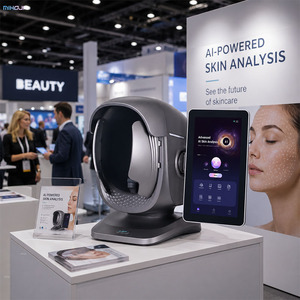
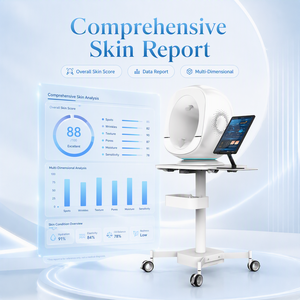
Modern clinical evaluation requires quantitative, non-invasive, sub-micron 3D facial topography scanning. As a premier manufacturer, supplier, and exporter of advanced 3D optical skin analysis platforms, our mission is to supply Houston-based dermatologists, plastic surgeons, cosmetic chemists, and aesthetic enterprise operators with medical-grade profilometry technology. By mapping the micro-relief of human skin in three dimensions, capturing precise volumetric changes, and decomposing spectral reflectance into distinct chromophore maps (melanin and hemoglobin), our instruments establish an unshakeable foundation for diagnostic rigor, treatment tracking, and regulatory submission.
Photometric Stereophotogrammetry
Multi-angle directional LED illumination models micro-surface normal vectors, generating absolute 3D topographical height maps ($Z$-axis accuracy in microns) without physical contact.
Multispectral Chromophore Unmixing
Separates light reflectance spectra into pure concentration maps of Epidermal Melanin and Dermal Hemoglobin, illuminating sub-surface vascular inflammation and hyperpigmentation.
Volumetric & Roughness Analytics
Calculates standardized skin roughness parameters ($R_a$, $R_z$, $R_q$) and precise cubic millimeter volume deltas for dermal filler evaluation and scar reconstruction.
Optical Architecture & Principles of 3D Facial Topography
Understanding the distinction between conventional "skin cameras" and genuine 3D Optical Topography Scanners is essential for medical directors and procurement managers in the Houston market. Standard digital cameras capture light intensity reflected from a flat plane, resulting in images that are highly sensitive to ambient lighting variation, shadow artifacts, and subject movement.
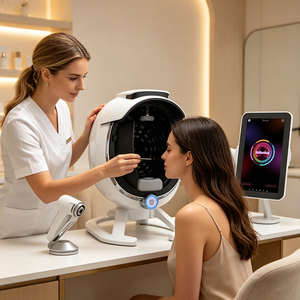
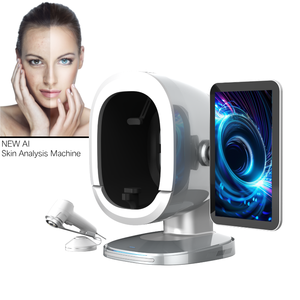
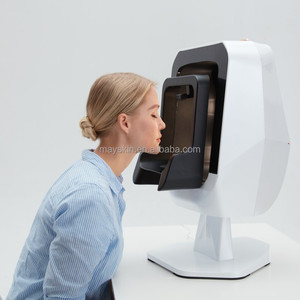
In contrast, our 3D Facial Topography Scanners—utilizing engineering principles referenced in leading clinical dermatological devices such as Miravex Antera 3D®—employ proprietary photometric stereo illumination paired with multi-spectrum light-emitting diodes (LEDs). By illuminating the facial surface from distinct, calibrated angles in rapid succession (cross-polarized, parallel-polarized, narrow-band UV, and near-infrared spectra), the optical sensor records subtle variations in shading across every single pore, wrinkle trough, and structural fold.
The mathematical engine computes the local orientation (surface normals) for each pixel, reconstructing a true mathematical 3D mesh of the facial terrain. This allows clinicians to quantify parameters with clinical reproducibility:
- Wrinkle Depth and Volume: Measuring absolute depression depth ($\mu\text{m}$) and total trough volume ($\text{mm}^3$) of nasolabial folds, periorbital rhytids, and forehead furrows.
- Surface Texture Roughness ($R_a$ / $R_z$): Utilizing ISO-standard industrial profilometry metrics to measure skin smoothness changes following fractional laser resurfacing, chemical peels, or microneedling treatments.
- Vascular Network Mapping: Isolating the specific spectral absorption coefficient of oxyhemoglobin ($542\text{ nm}$ and $577\text{ nm}$) to visualize telangiectasia, rosacea severity, and post-procedural erythema dispersion.
- Melanogenesis & Pigment Distribution: Quantifying melanin concentration layers to differentiate superficial epidermal freckles from deep dermal melasma prior to intense pulsed light (IPL) or Q-switched laser intervention.
Technical Modality Comparison: 2D Imaging vs. 3D Facial Topography
| Diagnostic Feature | Standard 2D RGB Imaging | Multi-View 3D Camera Systems | 3D Optical Topography Scanner (Our System) |
|---|---|---|---|
| Surface Height ($Z$-Axis) Precision | None (Flat pixel RGB grid) | Moderate ($\pm 150\ \mu\text{m}$) | Sub-Micron ($\pm 10\ \mu\text{m}$) |
| Illumination Sensitivity | High (Shadow distortions) | Medium (Requires fixed booth) | Immune (Controlled Polarized LED Array) |
| Quantitative Volumetric Delta | Incapable | Approximate mesh overlay | Exact ($\text{mm}^3$ Filler/Scar Volume Tracking) |
| Chromophore Deconvolution | RGB Color Estimation Only | Basic Filter Overlay | Spectral Hemoglobin & Melanin Unmixing |
| Clinical Trial Validation Data | Subjective Scale (GAIS only) | Limited Roughness Metrics | Publication-Ready Export ($R_a, R_z$, Depths) |
| Portability & Integration | High | Low (Large heavy booth) | High (Handheld or Compact Desktop Options) |
Houston Market Dynamics: Climate, Demographics & Clinical Demand
The Greater Houston metropolitan area presents a unique, demanding operating environment for medical aesthetics and dermatological care. As the fourth largest city in the United States, Houston's unique geographic and demographic realities drive specific technical requirements for facial analysis equipment:
1. Subtropical Climate & Sun-Damage Profiling
Houston experiences an average of over 204 sunny days per year with high UV index values throughout extended summer months. Prolonged solar exposure accelerates photoaging, solar lentigines, actinic damage, and premature dermal elastosis among local residents. Clinics in Sugar Land, Bellaire, and Katy require high-resolution UV spectral diagnostic tools to highlight hidden subsurface photo-damage before visible lesions manifest.
2. Diverse Fitzpatrick Skin Type Spectrum
Houston represents one of the most ethnically diverse populations in North America, featuring significant proportions of Fitzpatrick Skin Types III through VI (Hispanic, African American, South Asian, and East Asian populations). Standard analyzers often struggle with dark skin tones due to poor light absorption balance. Our multi-spectrum AI engines automatically adjust spectral gain to accurately measure hyperpigmentation and erythema across all Fitzpatrick skin types without optical bias.
3. Texas Medical Center (TMC) Research Rigor
With TMC hosting world-class institutions, clinical contract research organizations (CROs) and university dermatology divisions require rigorous, reproducible baseline data for clinical drug trials, anti-aging topical validation, and novel energy-based device testing. Our scanners export raw profilometric datasets, enabling statistical compliance with FDA clinical trial guidelines.
4. High-Yield Aesthetic Practice Competition
Aesthetic clinics in River Oaks, Memorial, and the Galleria district face intense commercial competition. Providing patients with interactive, objective 3D visualizations of their skin topography—demonstrating real micron-level improvements post-collagen stimulation or neurotoxin administration—dramatically increases patient retention, treatment trust, and cross-selling conversion rates.
Key Localized Application Scenarios in Greater Houston Practices
Scenario A: Post-Surgical & Injectable Volumetric Tracking in River Oaks Clinics
Plastic surgery centers and aesthetic injector practices in River Oaks and Memorial utilize our 3D Facial Topography Scanners to solve a classic clinical challenge: proving subtle volumetric correction to patients. Following hyaluronic acid dermal filler injections, biostimulatory treatments (e.g., Sculptra, Radiesse), or autologous fat transfer, patients often experience difficulty recalling their exact baseline facial contours.
By capturing matching pre- and post-procedure 3D topographical scans, our software performs automatic 3D alignment and generates a Volumetric Difference Heatmap. Areas of volume gain are highlighted in precise millimeter calibrations, allowing the physician to demonstrate exactly where volume was restored, measuring localized elevation changes down to 0.05 cc.
Scenario B: Clinical Trial Efficacy Validation in Texas Medical Center (TMC)
Cosmetic formulation laboratories and dermatological pharmaceutical teams operating within the TMC innovation corridor require quantifiable proof when evaluating topicals, growth factors, or energy devices. Using our 3D skin analyzers, researchers can measure changes in surface roughness ($R_a$), average pore diameter ($\mu\text{m}$), and total wrinkle area over 30, 60, and 90-day trial intervals.
Because illumination conditions are locked via polarized optical polarizers and fixed distance controls, inter-scan measurement variability is reduced to under 1.5%, establishing the gold standard of reproducibility demanded by institutional review boards (IRBs) and scientific journal peer reviewers.
Scenario C: Vascular & Rosacea Treatment Protocols in Galleria Med-Spas
Due to Houston's hot, humid summers, patients frequently present with exacerbated rosacea, persistent facial flushing, and sun-induced telangiectasia. High-end medical spas in the Galleria district utilize our spectral hemoglobin decomposition mode to map subsurface capillary networks. This enables practitioners to select precise wavelength parameters for vascular lasers (532 nm / 1064 nm Nd:YAG or IPL), and subsequently prove thermal vessel destruction upon follow-up scanning.
Enterprise Advantages & Manufacturing Excellence
As an established global developer, supplier, and exporter of advanced electro-optical dermatological machinery, our enterprise combines cutting-edge optical engineering with direct-factory wholesale value. When purchasing equipment for your Houston facility, our technical framework delivers distinct operational advantages:
Proprietary 30+ Diagnostic AI Engine
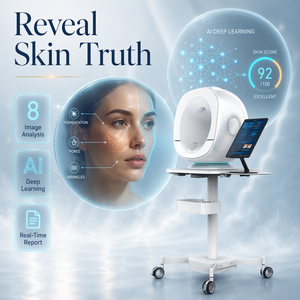
Our algorithms evaluate over 30 distinct skin health dimensions simultaneously—including deep UV spots, moisture retention indices, pore depth, sebum distribution, skin age estimation, and structural acne scarring.
HIPAA-Ready Multi-Language Software
Fully compliant with US patient privacy standards (HIPAA), featuring encrypted local and cloud database options. Supports up to 25 languages for seamless integration into multi-national clinics and clinical research hubs.
Direct Houston Logistics & Technical Support
Streamlined air and sea freight logistics directly to Port of Houston and George Bush Intercontinental Airport (IAH). Rapid replacement components, remote optical calibration support, and live technical service.
Procurement FAQ: Local Insights for Houston B2B Buyers
Request Wholesale Pricing & Technical Datasheets for Houston
Elevate your clinical research, plastic surgery practice, or medical spa with world-class 3D facial topography scanning technology. Connect with our engineering and B2B export team today.